Gamified habit tracking: what actually changes behaviour
July 15, 2026 · 5 min read
Somewhere on your phone there's a habit app you don't open anymore. For two weeks it worked. You logged workouts, watched a number climb, earned a badge shaped like a flame. Then the number kept climbing, nothing else changed, and one Tuesday you stopped logging and never noticed.
That arc is close to the default outcome for gamified habit tracking, and the reason is usually the same. Most gamification is points bolted onto a spreadsheet, and points stop mattering the moment the novelty does. Rewards can genuinely change behaviour, but only when they have a few specific properties. Most apps have none of them.
The reward has to land the moment you finish
Behaviour bends toward consequences that arrive quickly. A consequence that follows an action within seconds gets attached to that action; a consequence that arrives Sunday evening in a weekly summary gets attached to nothing. Your brain files the summary under "reading a report", not under "going for the run".
This is where most trackers quietly fail. Ticking a checkbox is immediate, but it's weightless. A weekly review has weight, but it's late. What you want is something that arrives at the exact moment of completion and is worth having.
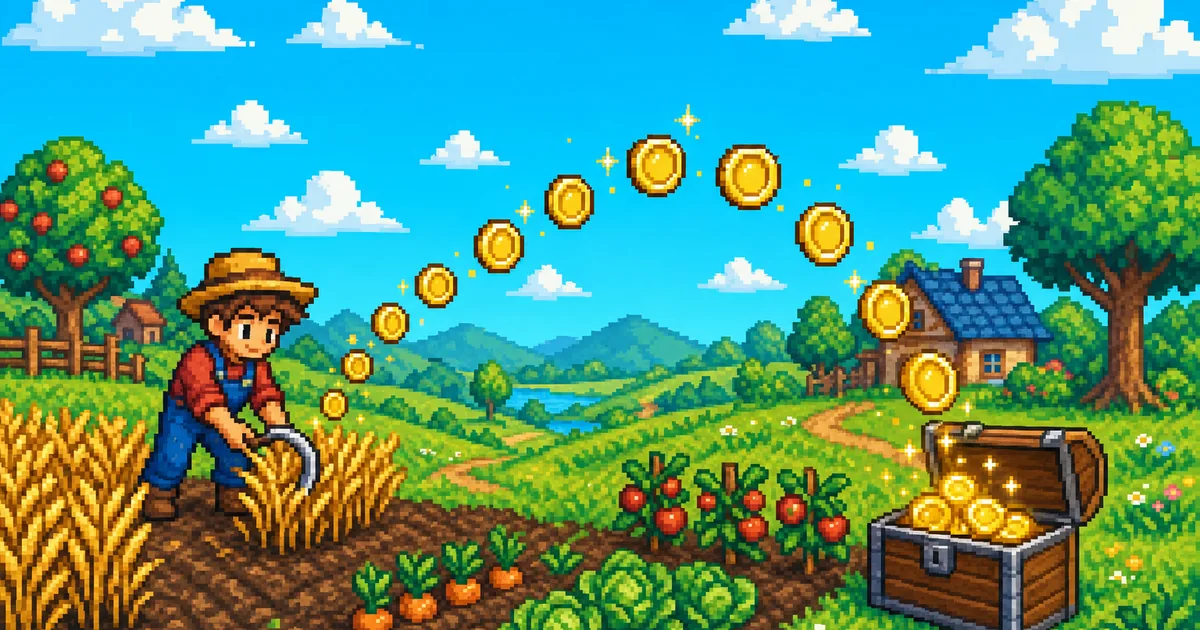
Meadow is built around that moment: you finish a real goal, and coins drop instantly. If you want to see what that loop feels like, start here.
A reward you spend beats a score you keep
Points that only accumulate turn into a scoreboard, and a scoreboard gives you nothing to want. Once the total gets large, one more point is a rounding error. The reward has stopped being a reward; it's a statistic about your past.
Spending changes that. In Meadow, coins buy seeds, water, land and decorations for a pixel-art garden, which means you're usually a few coins short of something specific. Pumpkin seeds cost 8 coins. If you have 6, tomorrow's goal is worth exactly what it takes to close the gap. Wanting something concrete is what makes the coin drop feel like anything at all, and wanting requires scarcity. A number that only goes up can't be scarce.
Fixed payoffs fade, variable ones hold
The other reason checkbox rewards decay is that they're perfectly predictable. Same action, same tick, same badge. Predictable rewards habituate; after a while your brain stops registering them, the way you stop hearing a fan that's always on.
Casinos solve this with randomness, which works but isn't something you'd want in a habit app. The better version of variability comes from choice. Meadow has 11 crops with different prices and payouts. A carrot costs 2 coins and sells for 8; a pumpkin costs 8 and sells for 26. Each crop moves through six growth stages. So what your coins become depends on decisions you make: which seeds, how much land, when to sell. The outcome varies because your plans vary, and that keeps the loop interesting long after a fixed badge would have gone invisible.
The overjustification problem
There's a real risk in attaching rewards to behaviour, and it's worth being straight about it. In 1971, Edward Deci found that college students paid to work on puzzles they already found interesting later spent less free time on those puzzles than students who were never paid. In 1973, Mark Lepper and colleagues found something similar with preschoolers: children promised a certificate for drawing later drew less on their own than children who were promised nothing. The pattern is called the overjustification effect. An expected reward for something you already enjoy can crowd out the enjoyment; the activity starts to feel like it's for the reward.
None of this makes rewards useless. It means they belong on the habits you don't do for their own sake. If you already love your morning run, it doesn't need coins. Flossing, stretching, the boring administrative task you've deferred for a month; those have no intrinsic pull to undermine, and an external reward is doing honest work. Point the gamification at what you avoid, not at what you love.
Why a garden beats a graph
A number that only goes up has no state. You can't neglect it, arrange it, or lose it, so you're not responsible for it. A persistent world is different. A garden, a pet, a base: each is an object that exists whether or not you're looking at it, with a condition that reflects what you've done. You planted those pumpkins. You chose where the path goes. Walking away means walking away from something particular, not from a statistic.
That sense of ownership is the quiet engine of the whole design. It's also why Meadow's streaks work the way they do: miss a day and the streak resets, and there's nothing to buy that undoes it. No streak freezes, no repair fee. A consequence you can pay to delete isn't a consequence, and a world with no way to disappoint you is just a screensaver.
The honest caveat: gamification can become a second job
Any reward system can invert, so that you start serving the game instead of the game serving you. The warning signs are familiar: logging things you didn't quite do, choosing goals because they pay well rather than because they matter, feeling dread instead of a small pull.
A few design choices resist this. Meadow has no friends list, no leaderboard and no account; your goals and garden live locally on your phone, so there's no audience to perform for. Photo proof is optional per goal: the app asks for a photo and checks it matches, which is less about policing you and more about removing the temptation to tap "done" on something you skipped. And the garden itself is deliberately small. Tending it takes minutes, and then it waits for tomorrow. If a habit app needs a habit tracker of its own, it has failed at the one thing it was for.
Finish real goals and grow something that lasts — try Meadow.